Meet Vicomtech: Generating 3D Worlds and Advancing
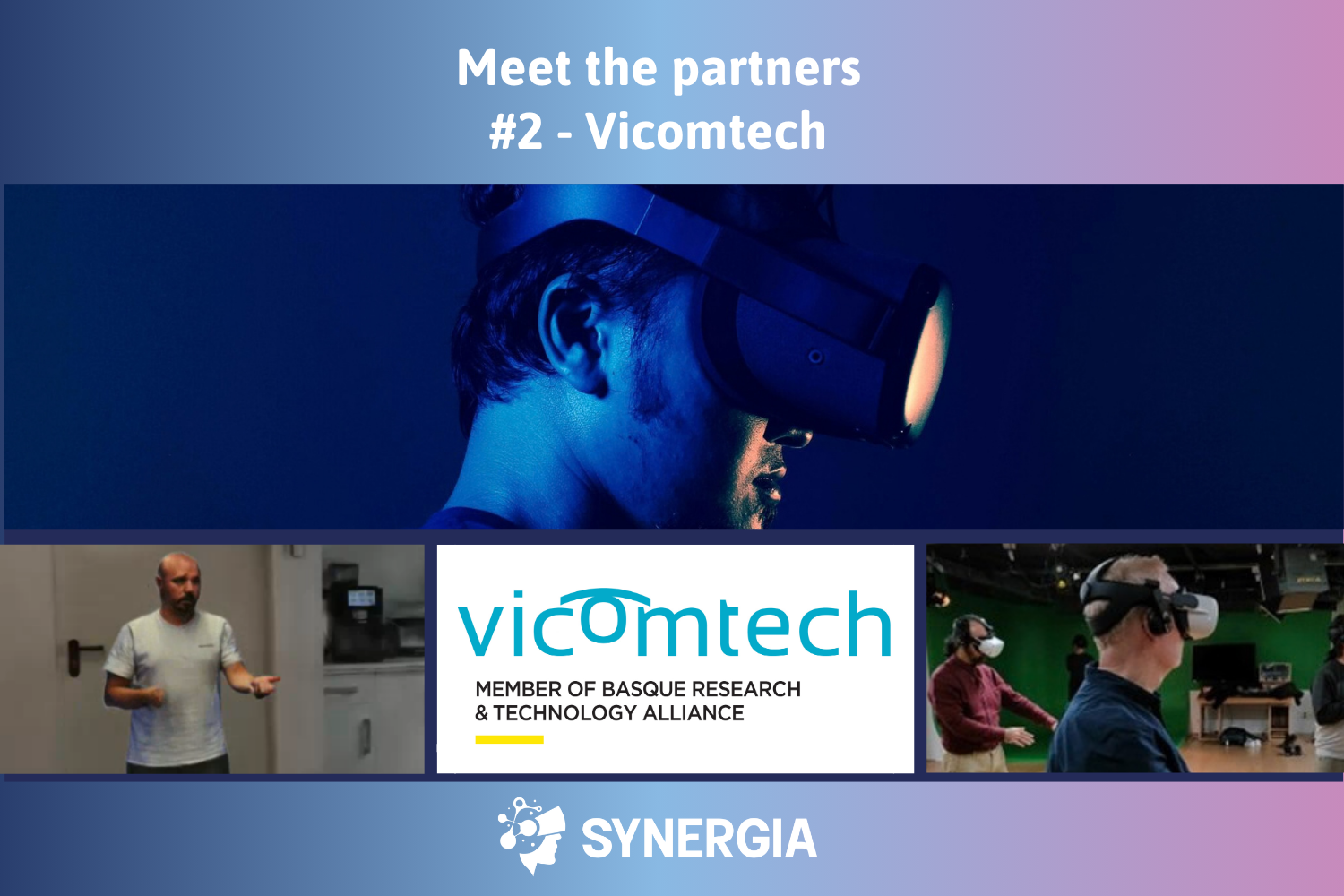
We continue our series introducing the partners behind SYNERGIA. Today, we are spotlighting Vicomtech, an applied research centre based in the Basque Country, Spain, specialising in Artificial Intelligence, Visual Computing and Interaction.
Within SYNERGIA, Vicomtech leads the development of the Generative Immersive World Creator, focusing on the use of Generative AI to create and adapt 3D assets and immersive environments. The team also contributes to the development of more inclusive and accessible interactions in XR.
Let’s find out more about Vicomtech and its role within the project.
Could you introduce your organization and its role in SYNERGIA?
Vicomtech is an applied research centre based in the Basque Country, Spain, specialising in Artificial Intelligence, Visual Computing and Interaction. It develops innovative digital technologies and solutions that help companies and organisations address real-world challenges and drive digital transformation. Vicomtech’s research and solutions are applied across a wide range of sectors, including manufacturing, mobility and transport, healthcare, energy, security or media. The centre collaborates closely with industry, universities, and other research institutions at both national and international levels. By transferring the results of its research projects to businesses, Vicomtech helps organisations improve their processes, products and services, and enhance their competitiveness.
Vicomtech will lead WP4 – Generative Immersive World Creator, focusing on the research and development of Generative AI models for the automated creation of 3D assets and immersive environments. Beyond generation, Vicomtech will also investigate techniques for modifying and adapting these elements at runtime, enabling dynamic and flexible immersive experiences. Additionally, Vicomtech will lead a task within WP3 – GenAI 3D Assistant, focusing on the adaptation of Large Language Models (LLMs) to provide inclusive and accessible text and dialogue. Finally, Vicomtech will actively contribute to the development and validation of several pilots, helping to evaluate the proposed technologies in real-world scenarios and ensuring their practical applicability.
What are you bringing to SYNERGIA, and what makes your contribution unique?
We will research and develop Generative AI models capable of creating realistic 3D assets and immersive environments from text or image inputs. We will also investigate techniques to modify and adapt the generated content dynamically at runtime, enabling immersive environments to evolve according to the context and user needs. To provide inclusive and accessible support to the users, we will leverage our experience in adapting Large Language Models and managing human-machine interactions to produce content in easy language varieties.
Our contribution is innovative in making these GenAI capabilities accessible to developers through a flexible and transparent platform. The platform will explore an agentic AI approach, allowing AI agents to select and orchestrate different models and tools according to the task and context. This will abstract the complexity of the underlying technologies while enabling different AI capabilities to be easily integrated, combined and adapted across the SYNERGIA pilots. Providing AI Assistants that are geared towards inclusiveness and accessible support is also a highly innovative contribution, which we will notably demonstrate within a Pilot centred on XR learning for persons with intellectual disabilities.
What challenges do you anticipate in SYNERGIA, and how will the project benefit Vicomtech?
As for the Generative Immersive World Creator, one of the main challenges is generating high-quality and realistic 3D assets and immersive environments that are also coherent and suitable for the target applications. Generative AI models have demanding computational requirements, so we will investigate efficient approaches for both training and inference. Another challenge is ensuring that the generated assets can be optimised for deployment on target devices, as well as developing efficient techniques for adapting content at runtime. In terms of model adaptation to provide inclusive and accessible interaction, there are many challenges, such as ensuring a tight understanding of user needs and input, providing content appropriately adapted to easy language varieties, and managing dialogues aligned with XR scenarios, among others.
SYNERGIA will allow Vicomtech to advance its expertise in Generative AI for 3D content and immersive environments, particularly in the generation of realistic and dynamically adaptable assets. The project will also strengthen our knowledge of agentic AI approaches for orchestrating different generative models and tools, as well as expanding the field of application of accessible and inclusive AI technology with adapted content in XR worlds. By validating these technologies in real-world pilots, SYNERGIA will help bridge the gap between research and practical applications, supporting their future transfer to industry.
Why is SYNERGIA an important project for the future of your field?
SYNERGIA is important because it explores a shift from static and manually authored virtual environments towards immersive worlds that can be generated and dynamically adapted by AI. The combination of agentic AI, generative 3D technologies, and Large Language Models adapted to provide inclusive and accessible content, can make XR applications more flexible and scalable, enabling virtual environments to evolve according to users, tasks and real-world contexts.
If SYNERGIA could achieve one breakthrough in your domain, what would it be?
If SYNERGIA could achieve one breakthrough, it would be to make the creation and adaptation of realistic 3D worlds as simple and natural as describing what you need. This would fundamentally simplify the creation of immersive applications and open up new possibilities for personalised and adaptive XR experiences across different sectors. Additionally, providing AI technology that can be successfully support users with different needs and abilities, via adaptation to easy language varieties in XR scenarios, would be a significant advancement in terms of accessible and inclusive technology.
This is the second article in our partner series. Stay tuned as we continue introducing the organisations contributing their expertise to SYNERGIA and working together to shape the future of XR.